


由香港大学(港大)物理学系研究人员参与的国际天文团队,首次取得决定性证据,证实至少部分快速射电爆发(Fast Radio Bursts, FRBs),即来自遥远星系、短暂但极为强烈的射电闪光——源自双星系统。这代表 FRB 的来源并非如以往所假设的孤立星体,而是属于由两颗互相绕行星体组成的双星系统的一部分。
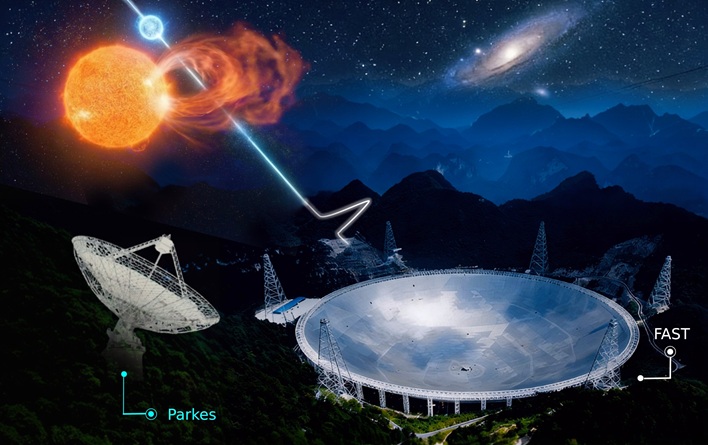
研究团队运用位于贵州、被誉为「中国天眼」的五百米口径球面射电望远镜(FAST),侦测到一项具关键意义的特殊讯号,显示产生 FRB 的天体身边,还有另一颗恒星与之共同绕行。这项突破性成果已经在著名学术期刊《科学(Science)》上发表。研究透过对一个活跃的重复型 FRB进行长达近20个月的持续监测,而该 FRB 位于距离地球约 25 亿光年之外的星系。
快速射电爆发之谜
FRB 所发出的射电波(以射电望远镜接收的无线电讯号),其偏振特性的变化可用来揭示 FRB 来源周围的环境。研究团队观测到一种罕见现象,称为「RM 耀发」(RM flare)——即射电讯号的偏振(Polarisation)特性出现突发性剧变。这种变化很可能是由附近伴星喷发的日冕物质抛射(Coronal Mass Ejection, CME)所引起,短暂影响了 FRB 源周围的环境。
论文通讯作者之一、港大物理学系天体物理学讲座教授兼香港天文与天体物理研究所所长张冰教授表示,这项发现为至少部分重复型FRB的起源提供了决定性的线索:「相关观测结果亦强力支持 FRB 来自一个包含一颗磁星(有极强磁场的中子星)和另一个类太阳恒星组成的双星系统。」
FRBs于 2007 年首次被发现,是来自银河系以外深空的射电讯号,持续时间极短(毫秒级),但亮度极高,至今仍是现代天文学中的未解之谜。虽然大多数 FRB 仅被观测到一次,但少数FRB源会重复爆发,为深入研究其物理机制提供了难得机会。
这些重复型 FRB 是 FAST 的理想观测目标。自 2020 年起,FAST 设立了专门的 FRB 优先重大科学计画,由张冰教授共同领导,持续监测这些FRB源,以研究其辐射特性及周围环境。
FRB 220529A是其中一个活跃的重复型 FRB,并一直被五百米口径球面射电望远镜(FAST)持续监测。张教授表示:「在初期观测 FRB 220529A时,它看似相当平凡;但在17个月长期监测后,终于出现了令人振奋的变化。」
追踪讯号穿越宇宙的过程
FRB 的一个显著特征,是其接近 100% 的线性偏振,显示其发射区域具有高度有序的磁场结构,这与磁星起源的理论完全一致。当射电波在磁化电浆中传播时,其偏振角会随频率旋转,这种现象称为法拉第旋转(Faraday rotation),并以旋转量(RM)作为量度。
过往研究显示,重复型 FRB 的 RM 通常较大,且会随时间变化。然而,这次观测到的行为则前所未见。
紫金山天文台与中国科学技术大学的论文第一作者李晔博士表示:「在 2023 年底,我们侦测到 RM 在极短时间内增加了二十倍。随后, RM 在约两周内迅速下降,回复至先前水平。我们将此现象称为『RM 耀发』。」
如此剧烈且短暂的 RM 变化,与一团高度磁化、高密度电浆(magnetised plasma)短暂进入观测视线的情况相符。
「最合理的解释,是FRB源附近存在一颗伴星,并抛射出这团电浆。」张冰教授解释说。
论文共同第一作者、云南大学的杨元培教授补充道:「这与我们在太阳及银河系其他恒星所观测到的日冕物质抛射现象高度一致。模型计算显示,所需的电浆性质完全符合恒星日冕物质抛射的特征。」
尽管距离极为遥远,该伴星无法被直接观测,但透过 FAST 及澳洲 Parkes 射电望远镜的长期高精度观测,其存在得以间接揭示。
紫金山天文台与中国科学技术大学的首席通讯作者吴雪峰教授表示:「这项发现应该归功于利用世界上最好的望远镜进行持之以恒的观测,以及我们团队成员孜孜不倦的工作。」
这项发现支持张冰教授及其合作者提出的统一物理模型。该模型指出,所有 FRB 均源自磁星,而位于双星系统中的磁星会因双星相互作用而更容易产生多次重复爆发。
展望未来
研究团队目前仍持续监测该 FRB 及其他重复型 FRB 来源。透过对重复型 FRB 进行长期系统性的观测,未来有望进一步揭示这些神秘来源中,双星系统出现的普遍程度。张冰教授总结说:「在过去五年中,FRB 不断带给我们新的惊喜,这正是这个研究领域的常态。我们期待迎接更多挑战与突破,逐步揭开这些宇宙谜团的全貌。」
合作与支持
本研究由来自四个国家、35 个研究机构的 38 位科学家合作完成,主要研究机构包括香港大学、紫金山天文台、云南大学,以及中国科学院国家天文台。
紫金山天文台的吴雪峰教授、国家天文台的姜鹏教授与朱炜玮教授,以及香港大学的张冰教授共同担任通讯作者。
研究获得国家自然科学基金及多项国内外科研资助。观测资料来自 FAST FRB 优先重大科学计画(由朱炜玮教授和张冰教授共同主持)、FAST 主任酌情时间计画(由吴雪峰研究员和姜鹏研究员共同协调),以及 FAST 与 Parkes 望远镜的 PI 观测计画(由李烨博士和张松波博士主持)。
【此处插入视频,与英文网站https://hkiaa.hku.hk/news/hku-astronomers-use-china-sky-eye-to-reveal-binary-origin-of-fast-radio-bursts/ 相同】
中国天眼揭示快速射电暴双星起源关键证据视频动画丨创作者:刘洋、杨轩、梁译方、张文龙、李晔
有关研究论文,可参看以下网址:https://www.science.org/doi/10.1126/science.adq3225
传媒如有查询,请联络港大理学院(电话:852-3917 4948/ 852-3917 5286; 电邮:caseyto@hku.hk / cindycst@hku.hk ) 。
香港大学报导原文:https://www.hku.hk/press/c_news_detail_28885.html
更多中文媒体报导:https://zqb.cyol.com/pad/content/202601/23/content_421548.html?isshow=1
A rare signal: the RM flare
Changes in the polarisation properties of radio waves can reveal the environment around an FRB source. The team observed a rare phenomenon known as an ‘RM flare’—a sudden and dramatic change in the polarisation properties of the radio signal, likely caused by a coronal mass ejection (CME) from a companion star that contaminates the environment of the FRB source.
‘This finding provides a definitive clue to the origin of at least some repeating FRBs,’ said Professor Bing ZHANG, Chair Professor of Astrophysics and Founding Director of the Hong Kong Institute for Astronomy and Astrophysics at HKU, and a corresponding author of the paper. ‘The evidence strongly supports a binary system containing a magnetar—a neutron star with an extremely strong magnetic field, and a star like our Sun.’
Monitoring repeating FRBs with FAST
Fast radio bursts are millisecond-long but extraordinarily bright radio flashes from beyond our Milky Way galaxy. While most FRBs are observed only once, a small fraction repeat, offering rare opportunities for long-term study and making it possible to detect unusual changes over time. These repeating sources have been closely monitored by FAST since 2020 through a dedicated FRB Key Science Programme co-led by Professor Bing Zhang.
FRB 220529A was one of the active repeating FRBs continuously monitored with FAST.
‘FRB 220529A was monitored for months and initially appeared unremarkable,’ said Professor Bing Zhang. ‘Then, after a long-term observation for 17 months, something truly exciting happened.’
Tracing the signal through space
FRBs are known for their near 100% linear polarisation. As radio waves travel through a magnetised plasma, their polarisation angle rotates with frequency—an effect known as Faraday rotation, measured by the rotation measure (RM).
‘Near the end of 2023, we detected an abrupt RM increase by a factor of twenty,’ said Dr Ye LI of Purple Mountain Observatory and the University of Science and Technology of China, the paper’s first author.
‘The RM then rapidly declined over two weeks, returning to its previous level. We call this an “RM flare”.’
Such a short-lived RM change is consistent with a dense magnetised plasma briefly crossing the line of sight.
‘One natural explanation is that a nearby companion star ejected this plasma,’ explained Professor Bing Zhang.
‘Such a model works well to interpret the observations,’ said Professor Yuanpei YANG, a professor from Yunnan University and a co-first author of the paper. ‘The required plasma clump is consistent with CMEs launched by the Sun and other stars in the Milky Way.’
Although the companion star cannot be directly observed at this distance, its presence was revealed through continuous radio observations with FAST and Australia’s Parkes telescope.
‘This discovery was made possible by the persevering observations using the world’s best telescopes and the tireless work of our dedicated research team,’ said Professor Xuefeng WU of Purple Mountain Observatory and the University of Science and Technology of China, the lead corresponding author.
The discovery also supports a recent unified physical picture proposed by Professor Bing Zhang and his collaborator, in which all FRBs originate from magnetars, with interactions in binary systems enabling a preferred geometry that allows more frequent, repeating bursts. Continued long-term monitoring of repeating FRBs may reveal how common binary systems are among these mysterious sources.
Collaboration and Support
The research was carried out jointly by HKU, Purple Mountain Observatory, Yunnan University, the National Astronomical Observatories of the Chinese Academy of Sciences, and other collaborating institutions. Professor Xuefeng Wu (Purple Mountain Observatory), Professors Peng Jiang and Weiwei Zhu (National Astronomical Observatories), and Professor Bing Zhang of the Department of Physics at HKU served as co-corresponding authors.
The project received support from the National Natural Science Foundation of China and other national and international grants from the collaborators. Observing time was provided by the FAST FRB Key Science Project (W.-W. Zhu and B. Zhang as Co-PIs), a FAST DDT program (coordinated by X.-F. Wu and P. Jiang), as well as FAST and Parkes PI projects (PIs: Y. Li and S. B. Zhang).
For related research papers, please refer to the following link: https://www.science.org/doi/10.1126/science.adq3225
China’s FAST Reveals Key Evidence of Binary Star Origin of Fast Radio Bursts
Video Animation丨Creators: Liu Yang, Yang Xuan, Liang Yifang, Zhang Wenlong, Li Ye. Original source: https://mp.weixin.qq.com/s/c2hp8wFuQ6uP67oITp7KqQ
View original press release: https://www.hku.hk/press/news_detail_28885.html
Read recent news coverage (in Chinese): https://zqb.cyol.com/pad/content/202601/23/content_421548.html?isshow=1