


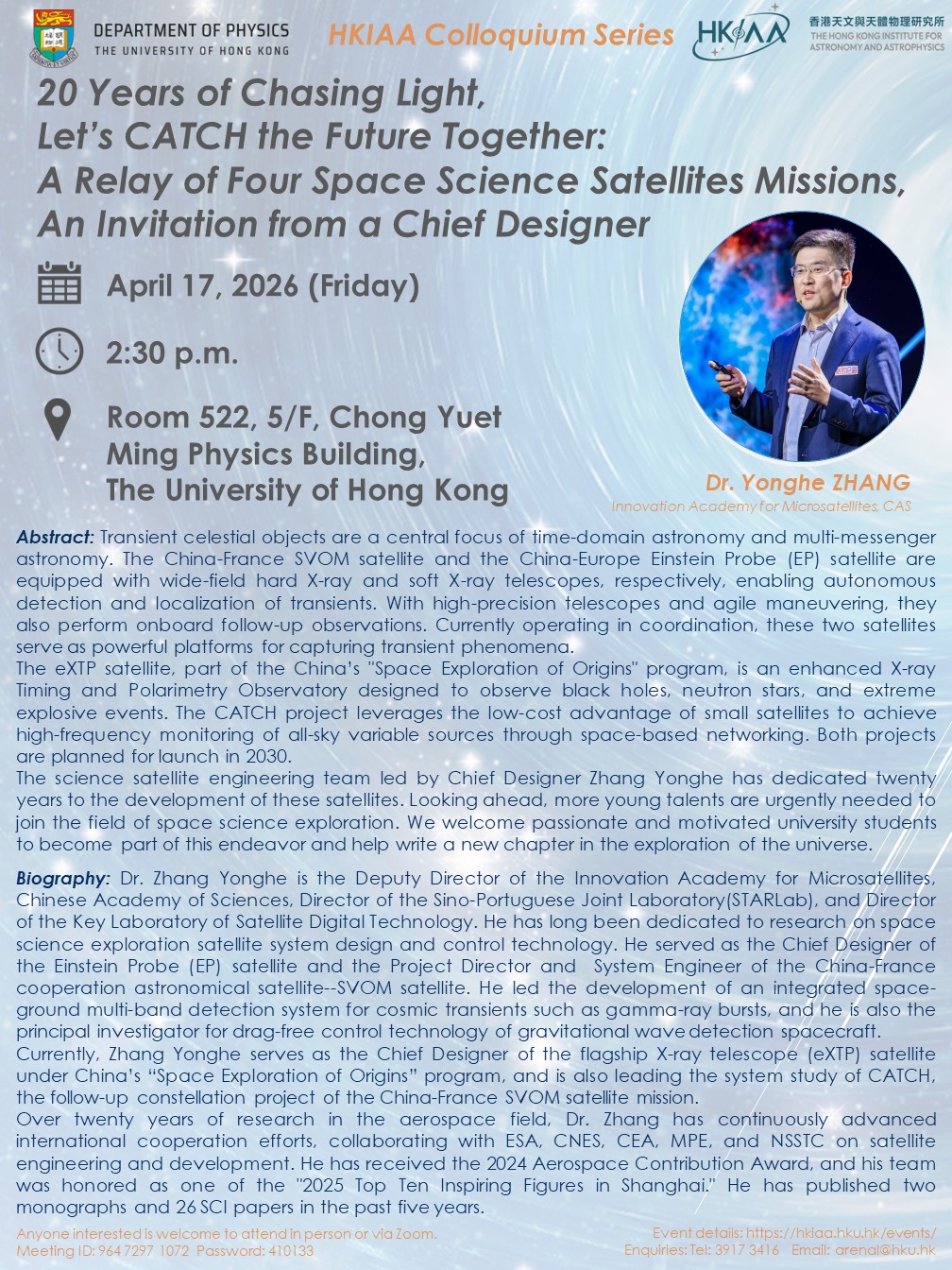
Room 522, 5/F, Chong Yuet Ming Physics Building, The University of Hong Kong
April 17, 2026 (Friday)
2:30 pm – 3:30 pm
Transient celestial objects are a central focus of time-domain astronomy and multi-messenger astronomy. The China-France SVOM satellite and the China-Europe Einstein Probe (EP) satellite are equipped with wide-field hard X-ray and soft X-ray telescopes, respectively, enabling autonomous detection and localization of transients. With high-precision telescopes and agile maneuvering, they also perform onboard follow-up observations. Currently operating in coordination, these two satellites serve as powerful platforms for capturing transient phenomena.
The eXTP satellite, part of the China’s “Space Exploration of Origins” program, is an enhanced X-ray Timing and Polarimetry Observatory designed to observe black holes, neutron stars, and extreme explosive events. The CATCH project leverages the low-cost advantage of small satellites to achieve high-frequency monitoring of all-sky variable sources through space-based networking. Both projects are planned for launch in 2030.
The science satellite engineering team led by Chief Designer Zhang Yonghe has dedicated twenty years to the development of these satellites. Looking ahead, more young talents are urgently needed to join the field of space science exploration. We welcome passionate and motivated university students to become part of this endeavor and help write a new chapter in the exploration of the universe.
Anyone interested is welcome to attend the talk in person or via Zoom:
https://hku.zoom.us/j/96472971072?pwd=uoTCtn45823IaLEyIkyrQvvZPjyt0C.1
Meeting ID: 964 7297 1072 Password: 410133
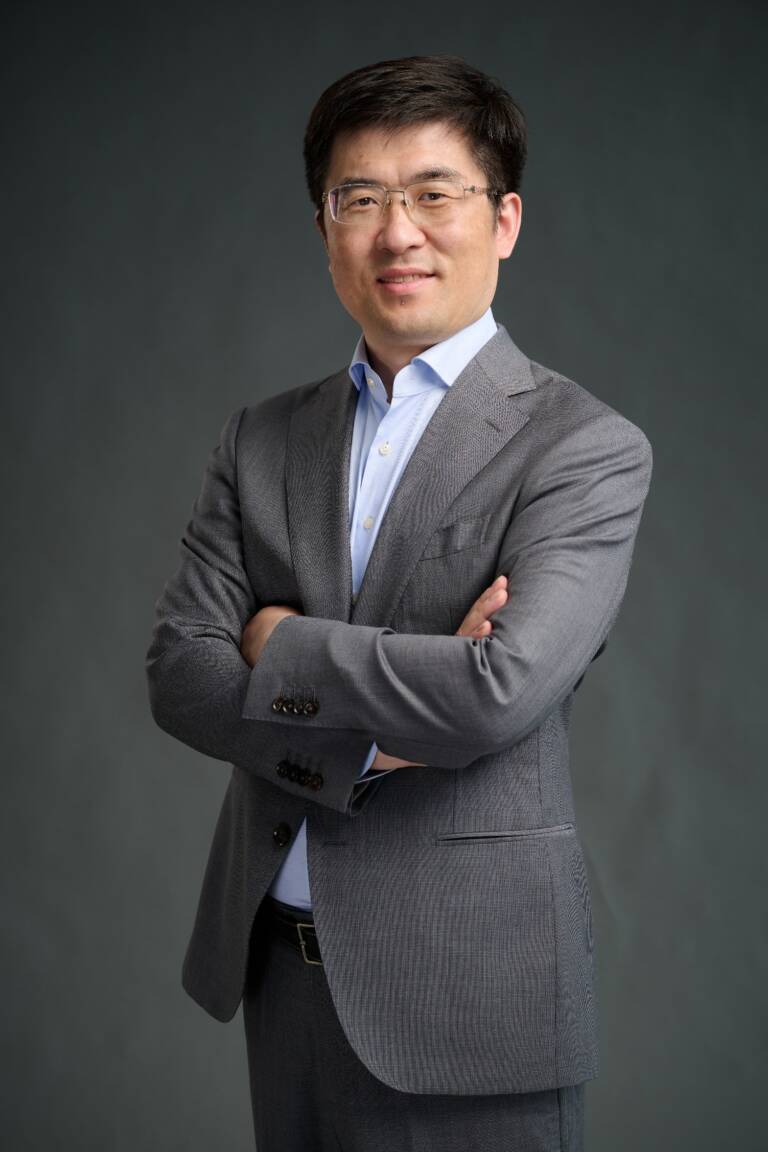
Dr. Zhang Yonghe is the Deputy Director of the Innovation Academy for Microsatellites, Chinese Academy of Sciences, Director of the Sino-Portuguese Joint Laboratory(STARLab), and Director of the Key Laboratory of Satellite Digital Technology. He has long been dedicated to research on space science exploration satellite system design and control technology. He served as the Chief Designer of the Einstein Probe (EP) satellite and the Project Director and System Engineer of the China-France cooperation astronomical satellite–SVOM satellite. He led the development of an integrated space-ground multi-band detection system for cosmic transients such as gamma-ray bursts, and he is also the principal investigator for drag-free control technology of gravitational wave detection spacecraft.
Currently, Zhang Yonghe serves as the Chief Designer of the flagship X-ray telescope (eXTP) satellite under China’s “Space Exploration of Origins” program, and is also leading the system study of CATCH, the follow-up constellation project of the China-France SVOM satellite mission.
Over twenty years of research in the aerospace field, Dr. Zhang has continuously advanced international cooperation efforts, collaborating with ESA, CNES, CEA, MPE, and NSSTC on satellite engineering and development. He has received the 2024 Aerospace Contribution Award, and his team was honored as one of the “2025 Top Ten Inspiring Figures in Shanghai.” He has published two monographs and 26 SCI papers in the past five years.