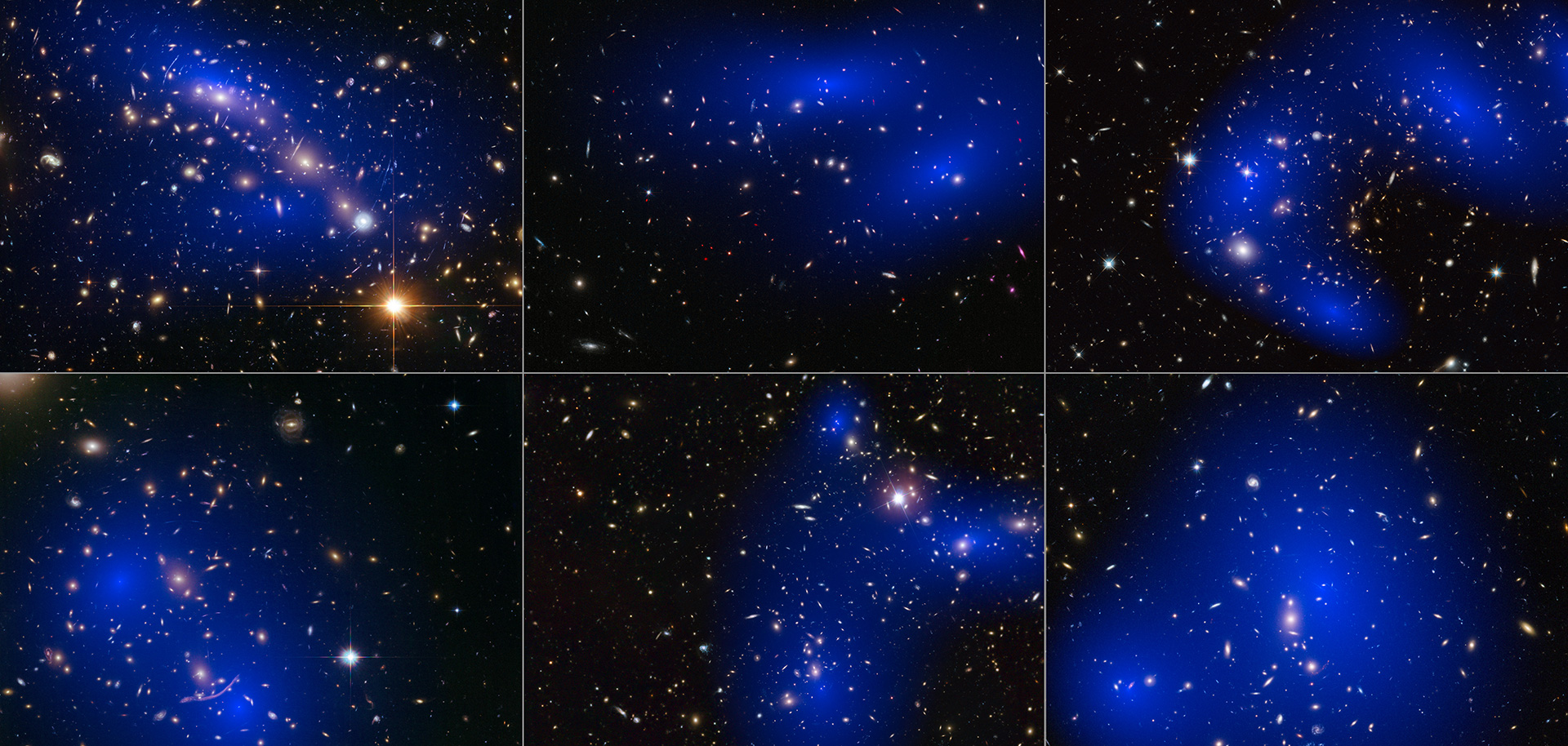
The majority of matter in the universe does not emit electromagnetic radiation. The nature of such Dark Matter (DM) is one of the leading problems in modern physics. The study of DM includes direct and indirect searches as well as using cosmological simulations to test competing models. The two main contenders for DM are ultra-massive WIMP-like particles or ultra-light Axion-like particles.
The HKIAA members are testing the contrasting predictions for the DM halos of individual galaxies, galaxy groups, and galaxy clusters through (strong) gravitational lensing, wherein multiple images of the same background galaxies are generated by the foreground cosmic lenses (Lim, Hannuksela). They also developing cutting-edge numerical simulations of DM halo and surrounding gas to study the evolution of the universe (T. K. Chan).
Many of our members study fundamental physics problems and their tests using astronomical observations. The topics include the nature of DM (Chu, Liu, Zhao, Zhong), searching for DM signals (Kenny C. Y. Ng, M. H. Chan), Higgs Boson (Liu), dark sectors (Zhao, Zhong), inflation (Wong, Wang), cosmic phase transition (Zhao), primordial black holes (Wang, Zhang), black hole structure (Wong), strange quark stars (Chu, Zhang), as well as using cosmic beacons to test the equivalence principle, photon mass, etc. (Zhang).