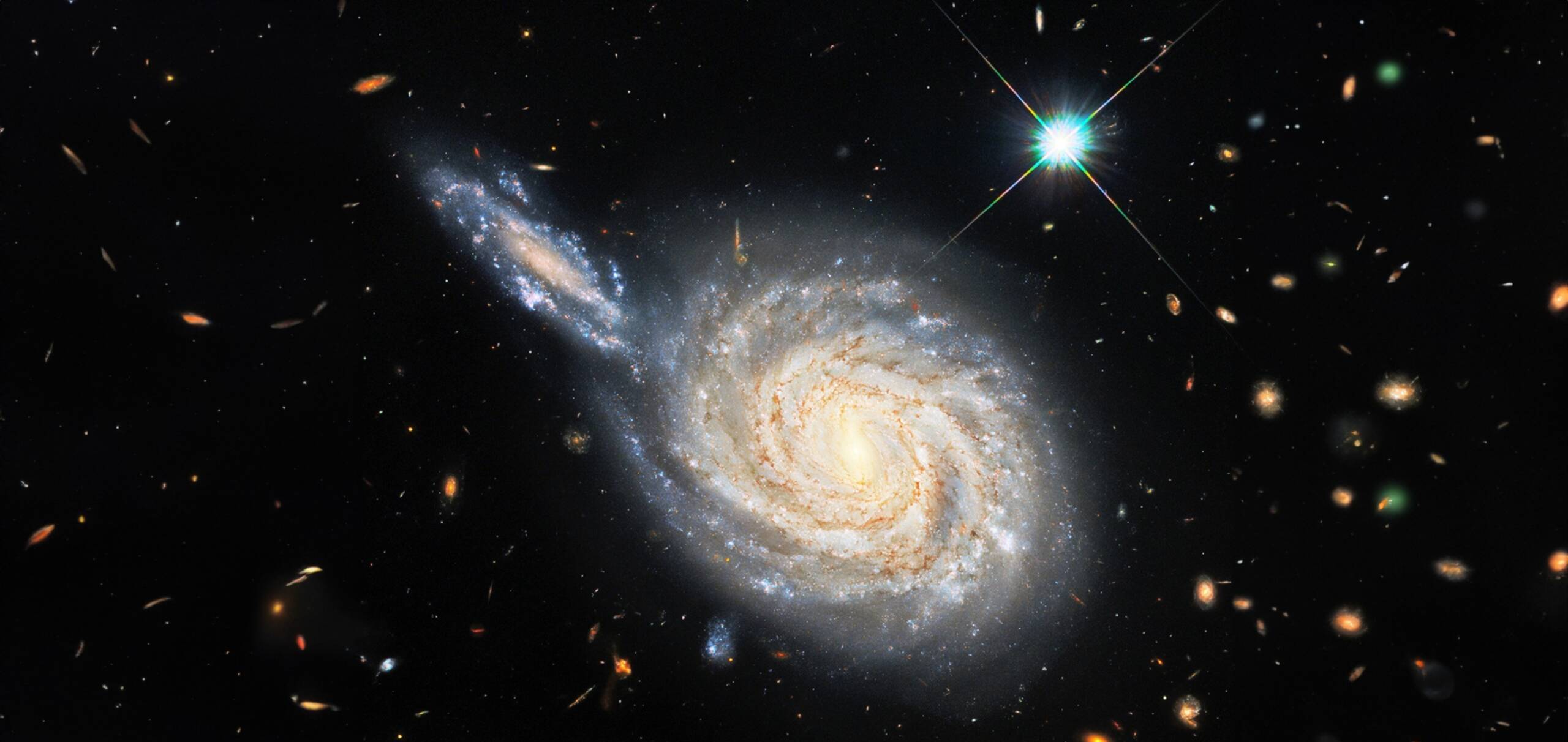
Research in galaxies and cosmology focuses on understanding how galaxies form, evolve, and interact, and how these processes connect to the origin of the Universe and its large-scale structure. Key themes include galaxy formation and evolution, the influence of active galactic nuclei on galaxy growth, the physics of the interstellar and circumgalactic media, and the supermassive black holes.
Another frontier in cosmology is to use various cosmic probes to constrain the cosmological parameters (such as Hubble constant, fractional composition of baryonic and dark matter as well as dark energy), which addresses the fundamental question of the ultimate fate of the universe.
Finally, the study of the early universe addresses most fundamental questions related to how the universe was born. Topics include inflation, primordial gravitational wave and neutrino backgrounds, as well as observational imprints at the cosmic microwave background.
The HKIAA members conduct various aspects of cosmological research, including multi-wavelength observations (Gu, Yan, Chen), advanced simulations of galaxy evolution (T. K. Chan, Lim, Chu), designing and building cutting-edge astronomical instrumentation (Yan, Chen), using cosmic probes to constrain cosmological parameters (Zhang), cosmic microwave background (Chu), and early universe problems (Chu, M. H. Chan, Wong, Zhao, and Zhong).