Black Holes at the Centres of Galaxies
Supermassive black holes are thought to lie at the centres of most massive galaxies. Although black holes themselves cannot be seen directly, their presence can be revealed by the way their gravity affects the motion of nearby stars. This same principle led to the discovery of the supermassive black hole at the centre of our own Milky Way, where Reinhard GENZEL and Andrea GHEZ resolved and tracked individual stars to measure its mass with high precision. They shared the 2020 Nobel Prize in Physics for this work.
Later studies measured black hole masses from the integrated motions of unresolved stars in nearby galaxies, typically within about 650 million light years from Earth. Pushing this approach to more distant galaxies, however, is extremely difficult: the region where a black hole’s gravity dominates is very small, making it usually impossible to resolve the sphere of influence across billions of light years.
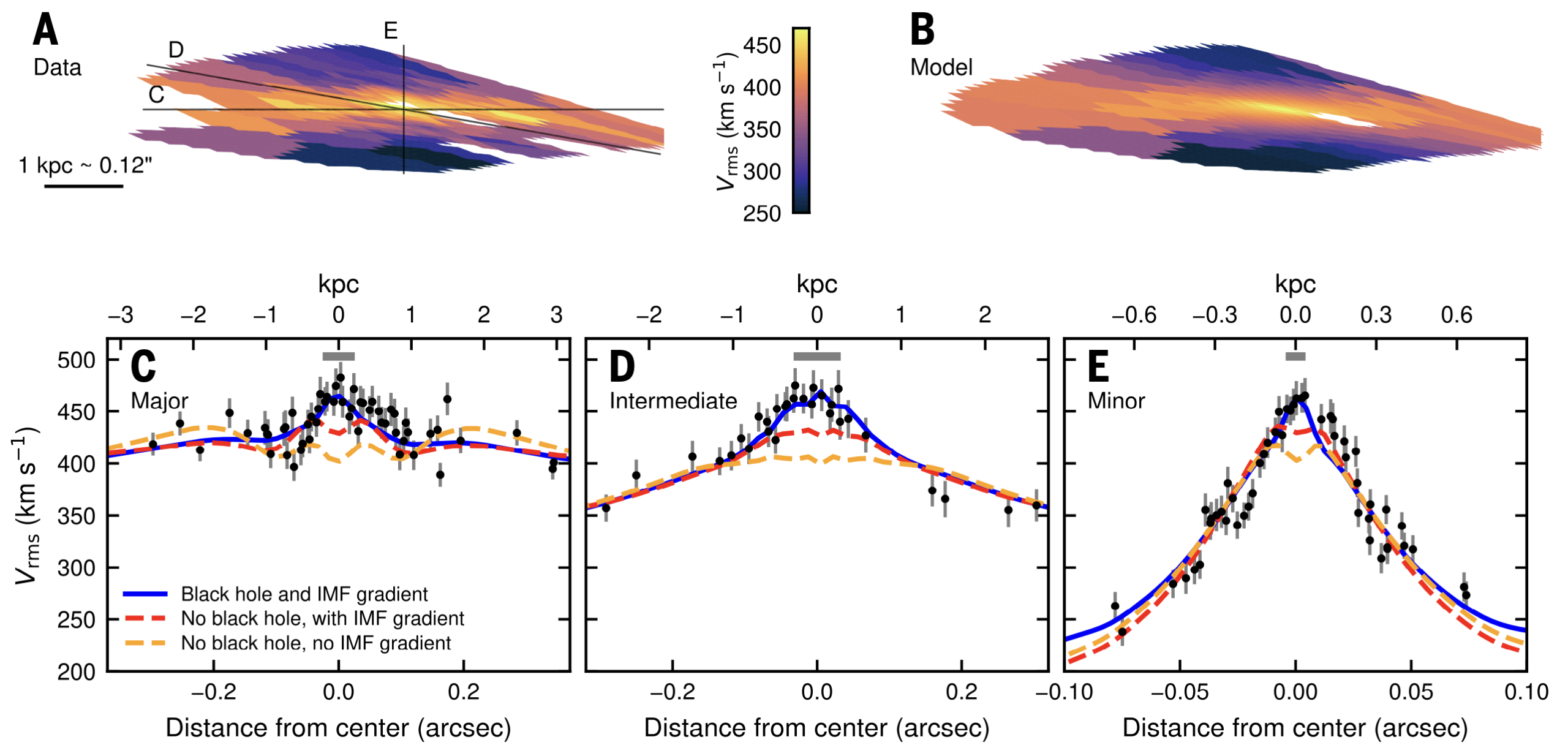
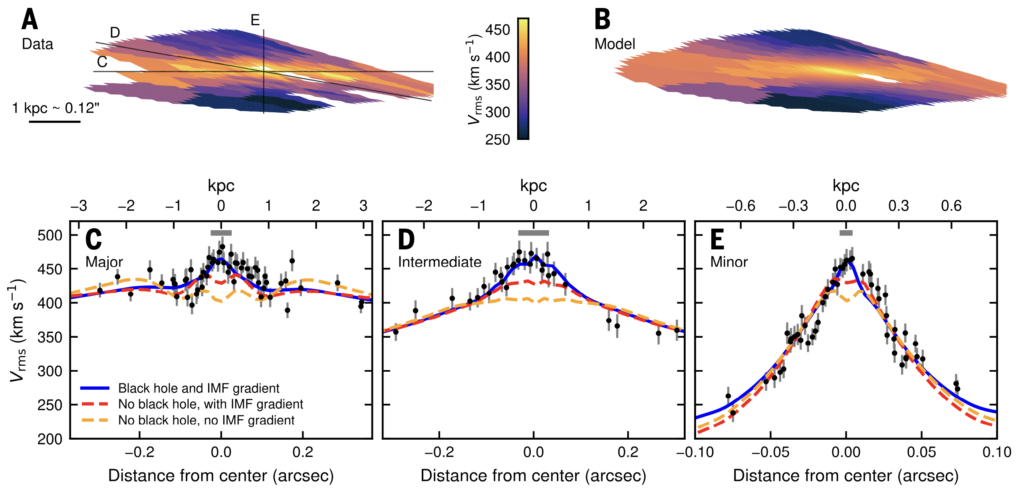
In this study, the team observed MRG-M0138, a massive galaxy seen as it was about 10 billion years ago, when the Universe was only about one quarter of its current age. At its centre, they found a dormant supermassive black hole with a mass of around six billion Suns.
The black hole is inactive, meaning it is not currently feeding strongly on surrounding gas and therefore does not shine brightly like a quasar. Instead of detecting it through light, the team detected it through gravity: the motions of stars near the galaxy’s centre revealed an enormous, highly concentrated mass, far too compact to be a cluster of stars and best explained by a single supermassive black hole.
How the Team Weighed the Black Hole
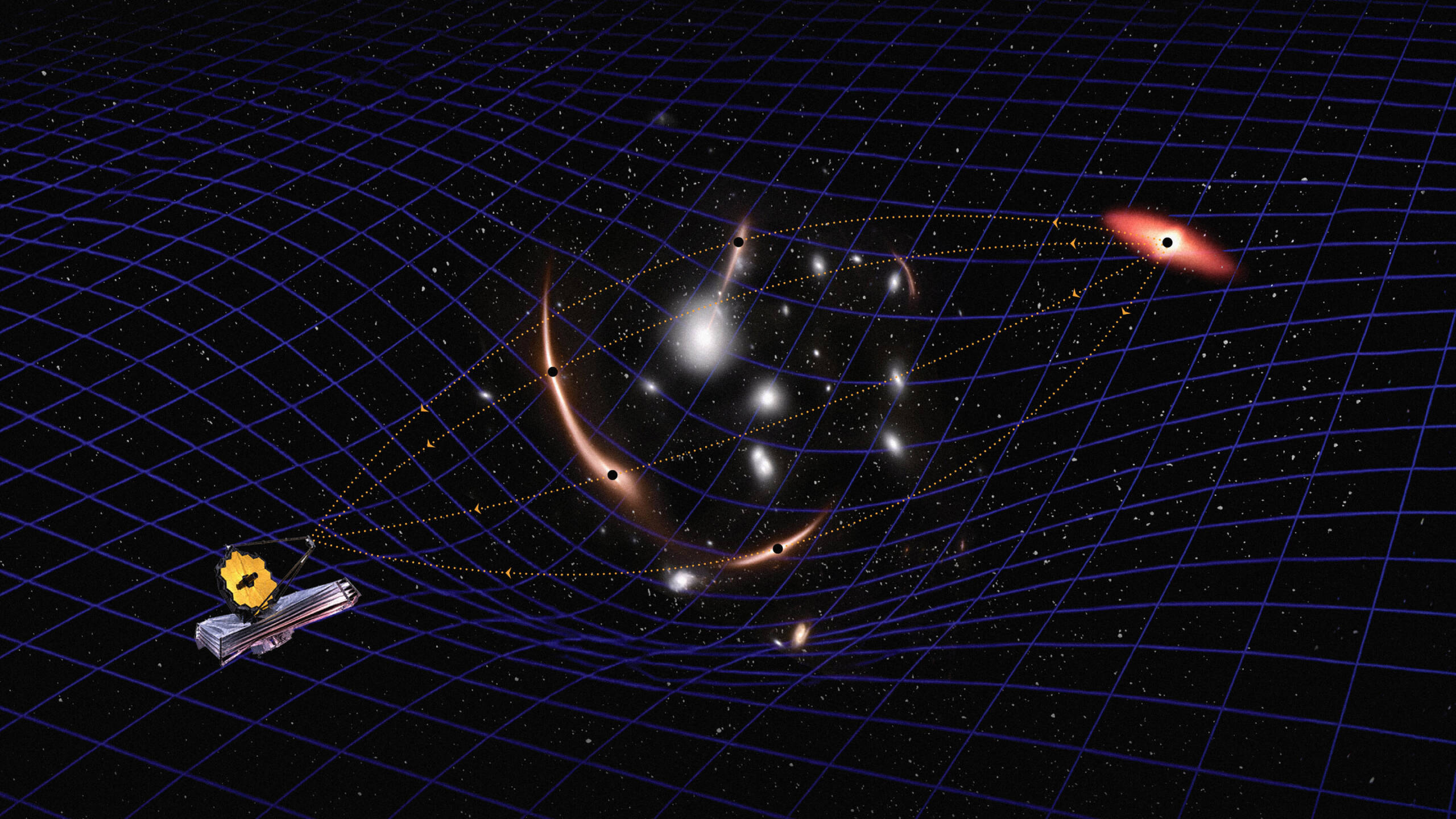
The measurement was made possible by the James Webb Space Telescope and gravitational lensing. A massive foreground galaxy cluster acted as a natural cosmic magnifying glass, magnifying the light of MRG-M0138 by about 30 times. This allowed the team to study the motions of stars near the galaxy’s centre in exceptional detail.
The result is surprising because the black hole appears too massive for its host galaxy — but only in one sense.
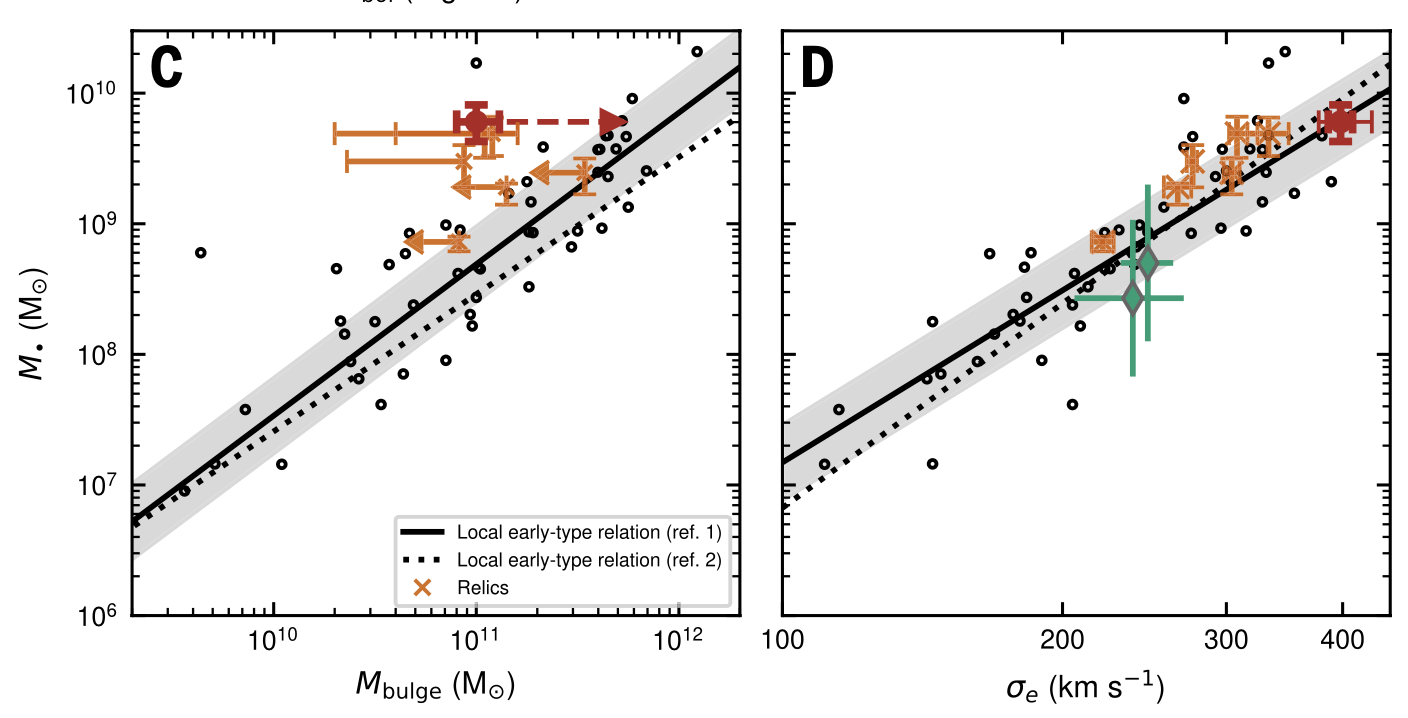
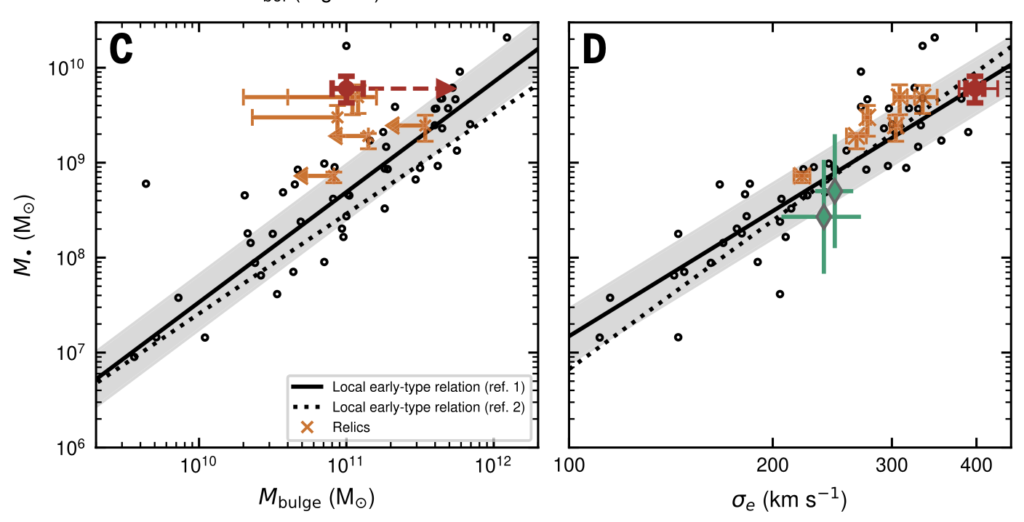
Compared with the galaxy’s bulge mass, the black hole is about 12 times more massive than expected from galaxies in the nearby Universe. Bulge mass refers to the mass of stars in the dense central part of a galaxy. In simple terms, MRG-M0138 had not yet built up enough stars to match such a huge black hole by today’s standards.
Yet compared with the galaxy’s stellar velocity dispersion, the black hole looks normal. Stellar velocity dispersion measures how much the stars’ speeds vary, reflecting the depth of the galaxy’s central gravitational potential.
Together, these two findings give astronomers an important clue. The black hole and the galaxy’s central stellar motions were already in place, while the galaxy still had to build up its stellar mass.
In other words, the central engine was already fully grown, but the galaxy around it was still catching up.